“In the beginning, [Yahwéh] Elohíym created the heavens [and their inhabitants],
Genesis 1:1, 31 ; 2:4b ; Psalm 33:6
then the earth [and its inhabitants]…And it was very good!” 1
“…In the day that Yahwéh Elohíym made the earth and the heavens.”
“By the spoken-word of Yahwéh the heavens were made
and by the breath of his mouth all their host.”
Behind the English translation, “The LORD God”, are the original biblical Hebrew names of
Yahwéh-Elohíym, and meaning: The one self existent–supernatural authority and power.
The “heavens” (plural in Hebrew) referred to here are not merely the visible skies, but also the invisible heavenly realms populated with spirit-beings who were created with the words, “Let there be light!”. The “earth” is not merely air, water, soil, and sky, but the appointed realm of physical embodied life. Thus creation begins with a complete cosmic order: heavenly and earthly, spiritual and bodily, all proceeding from the spoken-word and breath of Yahwéh-Elohíym. The heavenly realms are invisible to those embodied in the earthly realm unless one is given a special “vision” of them like those given to the prophets throughout the Scriptures.
Yahwéh-Elohíym desired & brought forth an everlasting family, and created environments to nurture them in freewill love & devotion. All was very good & in perfect order! But with freedom of choice, the potential for evil existed; and some in the heavenly realm rebelled against Yahwéh’s good order, and deceived humanity into transgressing Yahwéh’s covenant with them. The result was that the world became morally disoriented, alienated, and it was inherited by those who came afterward. So, here we are! But Yahwéh acted within history and eventually provided the remedy through the coming one. That one is the Lord Y’shúa (aka, Jesus), his Firstborn-Son chosen among all the sons of Yahwéh. He is Yahwéh‘s ambassador and agent sent from the Heavens, was faithful to his mission, and was martyred; But Yahwéh raised him from the dead. In this mystery, was provided the remedy of family reconciliation, and eventually a renewed world. Genesis 3:15 ; 2 Corinthians 5:18-22
This is a very brief summary of the story. But when the story was told, faith arose in our hearts. We believed the message, sought Yahwéh in prayer, felt his presence, committed ourselves to him, and our inner world began to change as we began communicating with him. And so we also teach the story, so that you have the opportunity to do the same. You have freedom to choose! We proclaim: Please, be reconciled to Yahwéh!!!
Yahwéh-Elohíym is self-existent being itself: infinite & eternal, the singular source, sustainer, & judge of all else—our Father & Mother—the ultimate All-in-One Parent. Yahwéh is loving & compassionate to all, reconciles & restores favor & fellowship to those who willingly turn to him, leading them to everlasting life. Elohíym is beyond what we can imagine but is also near supplying the very breath we breathe, and who uses these very words to make you aware of your need to awaken to him as if you had been spiritually sleep walking.
Read this prayer below a few times. Read it until you can, in sincerity, speak to Yahwéh who will hear you and will eventually communicate back to you in the various ways he chooses. Overcome the fears and doubts that will arise and choose life with your loving Creator.
“Whosoever [in sincerity] will call upon the name of Yahwéh [in prayer] shall be saved.” Acts 2:21; Rom. 10:13
“Now without faith, it is impossible to please Yahwéh; for the one who approaches him must believe that he exists and is a rewarder of those who seek him.” Hebrews 11:6 For I know the plans I have for you, declares Yahweh, plans for welfare and not for evil, to give you a future and a hope. Then you will call upon me and come and pray to me, and I will hear you.
You will seek me and find me, when you seek me with all your heart. Jeremiah 29:11-13
After reading it several times and pondering, Act on it by praying it and doing it:
1) I embrace you, Yahwéh—my Creator, “the only true Elohíym (God)”. You are loving & compassionate to all, and you listen to sincere prayers. Please forgive me for my sins & transgressions against you and others. Please reconcile & restore me to yourself, into your favor, fellowship, and the promise of everlasting life. Please help me and teach me the path of righteousness!
2) I embrace you Yahwéh, and Y’shúa—as your premier messenger of a new covenantal relationship established through him. In Y’shúa, you provided the remedy that reconciles us unto yourself. I embrace this remedy as it applies to all people who believe, trust, and obey. Acts 10:34-48
3) I embrace your command to return to you & be reconciled. I will confess my new loyalty to others. As an act of faith, I will immerse myself in water in the name of Y’shúa the Messiah2 who commanded it; and if possible,3 I will do so before a faithful teacher or witnesses who can guide me in this new path. I will continue learning what is pleasing to you. Please guide me in the way I should proceed & give me a faithful teacher! Blessed are you, Yahwéh, who hears sincere prayers! Acts 2:37-42
There is much to learn and a lifetime to learn it. I have given you the summary and it is sufficient to begin. If you must, continue reading. But, return here and embrace Yahwéh and Y’shúa and the Covenant. Faith is expressed in thoughts, words, and actions. Faith without corresponding actions is like a dead body without the soul. Email me, if you need to.
Embracing Yahwéh, Y’shúa, and the Covenant
The Israeli man, Y‘shúa (Yhwshúa, Yahushúa; Joshua, Jesus) of Natzareth, and his disciples, were called The Natsarím and also “The Qadoshím” (Holy Ones, Saints) and “The Way“. They consecrated themselves to walk in The-Path of Righteousness and Holiness in covenant with Yahwéh, the Ĕl of Yisra‘ěl, vowing to keep his commandments in union with Y’shúa and his family and disciples. His ministry was launched from the ministry of his cousin, the prophet, Yoḥanan (John the Baptist). These “…were first called, Christians, at Antioch” in Syria, in the late 1st century. [4] What were once synonymous terms, diverged into various hybrid sects after the first century. The original path is what we have sought to uncover, represent, and restore!
Below are prophesies written 700 years before Y’shúa was born to Yoseph and Miriam (Mary).
[Jesse was the Father of King David, ca., 1040-970 BCE. David is noted for being a prophetic Musician writing many Psalms/Songs, being anointed as King of Israel, uniting the tribes of Israel, and establishing Jerusalem as the capital of Israel. He received the promise that from his loins would come the Messiah. Y’shúa was a descendant of Jesse & King David.
Isaiah 11:1 A sprout will come out of the stump of Jesse,
and a branch/netsar out of his roots will bear fruit.
Isaiah 11:2 And The spirit of Yahwéh* will rest on him … [*Yahwéh = The Eternal Being]
Isaiah 42:1 Behold my servant…; I have put my spirit upon him [the Netsar]
6 … I, Yahwéh will give you as a covenant to the people, as a light to the nations…
Isaiah 52:13 – 53:12 6 All of us, like sheep, have wondered about; we each have turned to his own way;
and Yahwéh let fall on him the iniquity of us all. 7 …he was brought like a lamb to the slaughter…
11 …by his knowledge my righteous servant shall justify many; for he shall bear their iniquities…
Isaiah 58:12 Those who shall be of you shall be called …
“the Repairer of the broken walls” … “Restorer of paths to walk in”
who “rebuild the ancient ruins” and “erect the ancient foundations” …
Malachi 3:1 Yahwéh says, Behold, I will send my messenger [John the Baptist], and he shall prepare
‘the way’ before Me: and the Lord [Y’shúa ], whom ye seek, shall suddenly come to his temple,
even the messenger of the covenant [the Lord Y’shúa ],
whom ye delight in: behold, he shall come, says Yahwéh of the hosts [of the heavens].
Isaiah 61:1 The spirit of the Lord Yahwéh is upon me for he has anointed me to preach the Gospel…
This was quoted by Y’shúa when:
Luke 4:14 Y’shúa returned in the power of the Spirit into Galilee, and news about him spread through all the surrounding area. He taught in their synagogues, being glorified by all. He came to Natzareth, where he had been brought up.
He entered, as was his custom, into the Synagogue on the Sabbath day [the 7th Day of the Week = Saturday],
and stood up to read… saying, “The spirit of Yahwéh is upon me for he has anointed me to preach the Gospel…”
Acts 10:38 How Elohíym anointed Y’shúa of Natsareth with the holy spirit and with power, who went about doing good and healing all who were oppressed by the devil, for Yahwéh our Elohíym (The LORD our God in translations) was with him.
Clear and Sufficient Witness to Israel his People
Kepha (Peter) under the inspiration of Yahwéh, testifies to the Jewish crowds in Jerusalem:
16 “But this is what was spoken by the prophet Yo’ĕl (Joel 2:28-32)
17 ‘And it shall be in the latter days, says Elohíym, that I shall pour out of my spirit on all flesh.
And your sons and your daughters shall prophesy [that is, they speak under inspiration of God], and your young men shall see visions, and your old men shall dream dreams, 18 and also on my male servants and on my female servants I shall
pour out my my spirit in those days, and they shall prophesy [speak under inspiration of God]…
21 And it shall be that everyone who calls on the name of Yahwéh shall be saved.
Kepha (Peter) continues:
Acts 2:22 Men of Israel, hear these words: Y’shúa of Natzareth, a man attested to you by Yahwéh [our Elohíym/our God]
with mighty works and wonders and signs that Elohíym did through him in your midst, as you yourselves know—23 this Y’shúa, delivered up according to the determined plan and foreknowledge of Yahwéh, you crucified and killed by the hands of lawless men. 24 Yahwéh raised him up, loosing the pains of death, because it was not possible for him to be held by it…
36 Let all the house of Isra’el therefore know for certain that Yahwéh has made him both Lord and Messiah,
this Y’shúa whom you crucified. 37 Now when they heard this they were cut to the heart,
and said to Kepha (Peter) and the rest of the apostles,
“Brothers, what shall we do?” 38 And Kepha said to them,
“Repent [of all sin and transgression of the commandments of Elohíym] and be baptized, every one of you,
in the name of Y’shúa the Messiah for the forgiveness of your sins,
and you will receive the gift of the holy spirit. 39 For the promise [of the holy spirit of Yahwéh is for you and
for your children and for all who are far off, everyone whom Yahwéh our Elohíym calls to himself.
40 And with many other words he bore witness and continued to exhort them, saying, “Save yourselves from this crooked generation. 41 So those who received his word were baptized, and there were added that day about three thousand souls.
42 And they devoted themselves to the Apostles’ teaching and the fellowship, to the breaking of bread and the prayers.
The Apostle Kepha (Peter) said to Cornelius the Gentile who sought Yahwéh
Acts 10:38 …Now therefore we are all here present in the sight of Elohíym (God) to hear all things that have been commanded you by Elohíym.” 34 And opening his mouth, Kĕpha said, “Truly I see that Elohíym shows no partiality, 35 but in every nation, he who fears him and works righteousness is accepted by him. 36 “He sent the word to the children of Yisra’ĕl, bringing the Good News: peace through Y’shúa the Messiah! (He is Master of all).
37 “You know what word came to be throughout all Judea, beginning from Galilee after the baptism which John proclaimed:
38 how Elohíym did anoint Y’shúa of Natsareth with the holy spirit and with power, who went about doing good and healing all who were oppressed by the devil, for Elohíym was with Him. 39 “And we are witnesses of all he did, both in the country of Judea and in Jerusalem, whom they even killed by hanging on a tree.
40 “Elohíym raised up this One on the third day, and let him be seen, 41 not to all the people, but to witnesses, those having been chosen before by Elohíym – to us who ate and drank with him after he arose from the dead. 42 “And he commanded us to proclaim to the people, and to witness that it is he who was appointed by Elohíym to be judge of the living and the dead.
43 “To this One all the prophets bear witness, that through his name, everyone believing in him does receive forgiveness of sins.
44 While Kepha (Peter) was still speaking these words, the holy spirit fell on all those who heard the word.
45 They of the circumcision (the Judeans) who believed were amazed, as many as came with Kepha, because the gift of the holy spirit was also poured out on the Gentiles. 46 For they heard them speaking in other tongues and magnifying Yahweh [speaking under inspiration of Yahwéh]. Then Peter answered,
47 “Can any man forbid the water, that these who have received the Holy Spirit as well as we should not be baptized?”
48 He commanded them to be baptized in the name of Y’shúa the Messiah.
The Apostle Sha’ul was a Jewish “leader of the sect of the Netsarim (Nazoraios).” Acts 24:5
Standing before the Roman governor along with the Judean rulers, he described “The Way” of the Netsarim:
“And this I confess to you, that according to ‘The Way‘, which they call a sect, so I worship the Elohíym (God) of my fathers, believing all that has been written in the Law and in the Prophets, having an expectation, which they themselves also wait for, that there is about to be a resurrection of the dead [a raising up of people out of the realm of the dead], both of the righteous and the unrighteous. And in this,
I always exercise myself to have a clear conscience toward Elohíym and men.” Acts 24:14-15

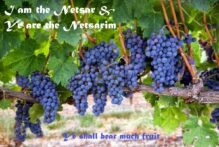
“I am the true Vine … (the true Netsar) [6]
and my Father (Yahwéh, “the only true God” … “my God and your God” John 17:3; 20:17)
is the Gardener … and ye are the Branches (the Netsarim, plural of Netsar);
he who abides in me and I (and my words) in him, the same shall bear much fruit … “
The above metaphor might provide a sense of familiarity for those familiar with the Gospel of John. But, the assumptions within the brackets and footnotes might make you pause and think a little deeper if you are not familiar with the added information and Hebrew words. If you are studious, you would look up the references and meditate upon them asking for insight from the Almighty. Many more brackets and footnotes could be added and you will find such orientation in this website. The truth contained in this metaphor is like a tiny seed that produces a great tree. So, please return and re-read and ponder and seek wisdom, understanding, and experiential-knowledge.
In accord with the above metaphor of the Supernal-Gardener who planted the True Vine (with its’ Branches and Fruit), I am Netsarian Fruit[1]which some spell as Nazarean, and there are various sects today with that name.. A “traditional” Christian might call me a Jew and a “traditional” Jew might call me a Christian–I have commonalities with both and sharp differences with both. Like all religions, they are hybridized religions containing truths and errors. I have learned from and appreciate the good people in all; I am part of all and yet, I am neither! How so? you might ask.
The difficulty in answering this question is this: What I actually say, may not be what you hear; for, we all hear in accordance with our own inherited life orientations, assumptions, definitions, biases, and maybe even studied opinions. We all have colored glasses like internal creeds through which we view the world. We easily make false-assumptions and jump to wrong conclusions.
Historical events and circumstances created different kinds of peoples spread out into the world, with each one preserving parts of the original truth of God. But, we tend to produce short labels to categorize peoples and dismiss them. Not wise! And, some, become confused and give up trying to attain the truth. Not wise either! Rather, one should be an eclectic, gradually sorting out the truth from the false like sifting ‘chaff from the wheat’ and rightly ordering the truths they contain without falling prey to false or adjusted narratives, inserted by deviant priests and philosophers. There are records and scriptures that most religious people are not aware that are worthy of consideration.
The Netsarim aka Qedoshim “…were first called, Christians, at Antioch…” in Syria, north of Israel. Acts 11:26b
What were once synonymous terms, diverged into various paths after the first century. 7
Disclaimer: Though I have places of overlap with various groups, ancient and modern,
that doesn’t mean I identify with all of their beliefs and practices. Nor do I necessarily accept what each one says about the others.
But I try to learn something from everyone. Maneuvering through everyone’s claims is no small task!
I sort through materials building upon my own path and experiences with Yahwéh. I am always willing to fine-tune!
In 375 A.D., A Roman Bishop wrote a book[2]Brackets are mine, inserted to clarify, reorder, and simplify his descriptions in various chapters and narrow in on the pertinent statements. We have used the Prophet Isaiah’s Hebrew term, Netsar … Continue reading about various sects/denominations of his day from the perspective of his own Roman Catholic denomination, who had already drastically redefined “The Way”. He said,
“This sect of
– The Netsarim or Nazoreans … [3]We have used the Prophet Isaiah’s term, Netsar (Is 11:2), instead of the Bishops’ Greek translation, Nazoreans, a term which is also confused in the New Testament with the similar sounding … Continue reading [They possess the Original Gospel of Y’shúa written in Hebrew.] This sect is to be found in Beroea near Coelesyria, in the Decapolis near Pella, and in Bashanitis at the place called …Khokhabe in Hebrew … [The Bishop says, in his disgust,] They are nothing but Jews [except for their fidelity to Iesous (Jesus) the Christos = the Hebrew means: Y’shúa the Anointed One [Is. 61:1: Lk. 4:16-19] … [since, unlike his own Roman sect who had distanced themselves from the “Jewish” Nazoreans, redefined God and Jesus, altered their Calendar, changed the Sabbath Day from Saturday to Sunday, altered Festival Days, and other practices of “the Jews”.]
[Likewise, the Essene (Assayin) Sect of]
– The Nasareans...[“Eagles” Ex. 19:4 & Is 40:31][4]Nasharim or Nasareans comes from the word for Eagle (Nashar) and is rooted in the word, Nasa – to Ascend; Strongs #’s H5404, H5376), from Exodus 19:4 “You have seen what I did to the … Continue reading They are Jews by nationality, from Gileaditis, Bashanitis and the Transjordan as I have been told, but descendants of Israel himself.” There are only a handful of Nasarians [left as such, for] … they have been united with the sect of
– The Ebionites [“the Poor” due to their consecration; Matthew 5:3], who also possess the Original Gospel of Y’shúa written in Hebrew. They both also reject animal sacrifices and flesh eatingclaiming that it was part of a fraudulent editing of the Scriptures or something only grudgingly & temporarily permitted by God because of “the hardness” of their hearts, and thus, they also read the Scriptures with discernment and have other Sacred Writings as well. [5]Some of them at some point rejected the Apostle Paul’s writings, which probably meant they, in reality, simply rejected the twisted interpretations of Paul’s letters by later Christians … Continue reading
Similarly,
– The Ossayin are “the Doers of the Law” James 1:22. They also abstain from eating the flesh of animals.
And have you ever read the Clementine Homilies and Recognitions? also called by this Bishop, The Travels of Peter? These books contain the same teachings as those listed above and Bishop Epiphanius said they were read by the Ebionites—another name for Nazoreans/Netsarians.
Bishop Epiphanius, The Panarion (c. 375 AD)
A Nicene Bishop, an enemy of the Netsarim who was on the outside trying to look in and describe them!
Remember the Victors of war write or re-write the story in their own favor.
Obviously, these groups were interrelated if not identical and were at odds with the doctrines of what won out as “orthodox” Judaism and “imperial” Christianity with the aid of the Roman Sword. I have attempted to restore them. We place these other groups under the one broad title: The Netsarim, disciples of Y’shúa,The Netsar/The Nazarene.
A wealth of implications are contained in this synopsis and are elucidated on this website. I have learned over the decades when going through a spiritual or mental “paradigm shift”, that it is a matter of rethinking and fine-tuning my knowledge rather than becoming disillusioned and “throw the baby out with the bathwater”. My Faith, Trust, and Faithful-Obedience (Emunah) has remained strong as I have sought Yahwéh, the Most High, every step of my path. Short answers are not sufficient. Thus, my Lord Y’shúa said, “He who has ears to hear, let him hear!” The one who has ears to hear is the one who is willing to hear until understanding comes and then become an obedient doer of the message–that is, begin implementing the message.
Welcome to Netsarim.com
The Israeli Netsarim “…were first called, Christians, at Antioch…” in Syria, north of Israel.
Isaiah 11:1 A shoot will come out of the stump of Jesse, [the Father of King David]
and a branch/netsar out of his roots will bear fruit.
Isaiah 11:2 The spirit of Yahwéh*will rest on him …
Isaiah 42:1 Behold my servant…; I have put my spirit upon him [Y’shúa the Netsar]
6 … I, Yahwéh will give you as a covenant to the people, as a light to the nations…
Isaiah 52:13 – 53:12 6 All of us, like sheep, have wondered about; we each have turned to his own way;
and Yahwéh let fall on him the iniquity of us all. 7 …he was brought like a lamb to the slaughter…
11 …by his knowledge my righteous servant shall justify many; for he shall bear their iniquities…
Isaiah 58:12 Those [The Netsarim & their Fruit] who shall be of you
shall be called … “the Repairer of the broken walls” … “Restorer of paths to walk in”
who “rebuild the ancient ruins” and “erect the ancient foundations” …
Malachi 3:1 Yahwéh says, Behold, I will send my messenger [John the Baptist], and he shall prepare
the way before Me: and the Lord [Y’shúa the Netsar], whom ye seek, shall suddenly come to his temple,
even the messenger of the covenant [Y’shúa the Netsar, the Anointed],
whom ye delight in: behold, he shall come, says Yahwéh of hosts.
Isaiah 61:1 quoted by Y’shúa : The spirit of the Lord Yahwéh is upon me for he has anointed me to preach the Gospel…
* “I Am that I Am” (Aheyéh asher Aheyéh) is speaking in first-person-singular of an absolute state of Being that we as creatures cannot comprehend. We can only use metaphors to compare our own reality to “It” — the Infinite Being. Reflecting this, the name revealed to Moses at the burning bush in Exodus chapter three was, Yahwéh. It is a third-person-singular name that translates as,
“He-Who-Is” and “He-Who-Causes-Existence; “The Eternal One” or The Only Eternally-Self-Existent One,
The Source from whom all other existence exists!
- We prefer the original Hebrew names over the hybrid European translations of “The LORD”, “God”, and “Jesus Christ” and one should become familiar with them and use them. We prefer them but that doesn’t mean that the other forms are evil or pagan as some erroneously teach. Yahwéh knows our hearts and intentions even when we, like children, make mistakes. Yahwéh is good and his mercy and compassion endure forever! ↩︎
- The baptismal command in Matthew 28:18–20 should be understood in a Unitarian way in light of the authority Y’shúa himself declares to have received from Yahwéh the Father: “All authority has been given to me in heaven and on earth.” Y’shúa therefore sends his disciples to teach all nations and to baptize under his commission—that is, under his name, authority, and authorization as the Firstborn Son, sent, authorized, and anointed by Yahwéh—the infinite and eternal Spirit, who is holy (set-apart in an exclusive category of his own—one impossible for anyone else to share).
The familiar wording, “in the name of the Father, and of the Son, and of the Holy Spirit,” has often been used as a baptismal formula. In later Christian history, especially from the fourth century onward, it was also read through the lens of Trinitarian doctrine, as though it taught that the One God is three co-eternal, co-equal Persons of one essence. That doctrine, in my judgment, is erroneous and was historically enforced by imperial power. Yet the baptismal wording itself does not require such a meaning. Properly understood, it is not Trinitarian but Unitarian, in harmony with the rest of Scripture.
The Book of Acts shows the apostolic practice plainly. Baptism is repeatedly performed “in the name of Y’shúa the Mashíakh” or “in the name of the Lord Y’shúa” (Acts 2:37–42; 10:48). This does not exclude Yahwéh, but rather presupposes him, for Y’shúa acts as the authorized Son and agent of Yahwéh. The apostolic proclamation also draws upon the prophet Joel:
“Whosoever will call upon the name of Yahwéh shall be saved.”
Thus, baptism is rightly performed while calling upon the name of Yahwéh, the Father-Mother, through the authority of Y’shúa, his Firstborn Son, in the power of the Holy Spirit of Yahwéh.
Matthew 28:18–20 may therefore be understood as follows:
“All authority has been given to me in heaven and on earth. Go, therefore, and make disciples of all nations, baptizing them in the name [that is, under the authorization] of the Father and of the Son and of the Holy Spirit, teaching them to observe all things that I commanded you. And behold, I am with you always, even to the end of the age.”
That is:
In the name / authorization of the Father — Yahwéh-Elohíym, the infinite and eternal Spirit, whose name and authority stand above all.
And of the Son — the Firstborn Son of Yahwéh, born and named Yahushúa, abbreviated as Y’shúa, meaning “Yahwéh will save”; the one sent, authorized, and anointed by Yahwéh.
And of the Holy Spirit — the Holy Spirit of Yahwéh, is like breath breathed out of someone. It proceeds from Yahwéh into and through the Son, bringing his presence, manifested in various ways. It is given to his sons and daughters and brings his presence as a seal and foretaste of future bliss.
Therefore, these words do not teach the later doctrine of the Trinity. They testify to Yahwéh as the One God, to Y’shúa as his authorized Son and Anointed One, and to the Holy Spirit as the Spirit of Yahwéh influencing and working among his people. For this reason, even where a Trinitarian minister has used the traditional wording, Yahwéh in his mercy may still honor the baptism, because the words themselves—rightly understood—confess the Father, the Son, and the Holy Spirit in a Unitarian order, not a Trinitarian one. ↩︎ - Why self-immersion?
In the Hebrew pattern, immersion is not primarily an institutional ceremony performed upon a passive subject, but an embodied act of repentance, cleansing, and covenantal return before Yahwéh performed often. When faithful witnesses or teachers are available, they are valuable; but when a sincere seeker cannot find a non-Trinitarian teacher, self-immersion in the name of Y’shúa is a fitting act of faith and obedience. Yahwéh is merciful, and each soul walks according to the light given in its appointed path. ↩︎ - (Acts 11:26) The Book of Acts was finished in about AD 62–about the same time that Ya’aqob (James, the Brother of Y’shúa, and the Leader of the Netsarim) was murdered at the Temple in Jerusalem. The earliest manuscript of a portion of Acts that we now have is about AD 200-250. Obviously, they were called by the Hebrew name, Netsarim (Grk: Nazaraios). They were later, at some point, called by the Greek term for Messiah, Christianos, at Antioch. Notice that neither Paul or any other writer in the NT ever used the name, Christian, except once in 1 Peter; and this may have been changed from Natsri. (The question is, When was the first time and when did it become the dominant term? Was it original to the writing of Acts or was this phrase inserted as a parenthetical note added by a later copyist? And, if so, what was the motivation for inserting it; and, what is the latest date that it could have been inserted? AD 70? 100? 135? The polemical Pseudo-Ignatius Letters? Could it have been polemical, as an effort to disassociate themselves from the original Jewish Netsarim and their continued practices (—not of the priestly “bloody-ritual-works of the Law” but of “the righteousness of the Torah-Law”(Rom. 8:4)—its’ moral laws and wisdom, including, Sabbaths, Festivals, Foods, etc.?) Can one find evidence of a split and a broadening gap between Netsarim and Christianos in the 2nd Century? How wide did the gap between them eventually get? We only find in the New Testament the term, Christian, three times: Acts 11:26; 26:28; 1 Peter 4:16. Were these terms changed from Netsari to Christian as part of an effort to make a distinction and widen the gap? Maybe, maybe not. It may have been synonymous originally. But, it is clear that later “Christians” criticized the “Netsarim” as aberrant & different from themselves. Christian is not at all a bad term and can be a natural progression with the Greek language–Christ & Christians and perhaps was so. But, when and if a designation becomes loaded with specific historic developments, one may not want to be associated with that designation. They were also called “The Way”. The term most used to designate them in the New Testament is Saints or Holy Ones — those consecrated and set apart to follow Y’shúa the Netsar, the Messiah (Christos), and the restored walk the Path of Righteousness and Holiness that he outlined. It was a path that separated one from those on other paths. ↩︎
- The name, Jesus, comes from the Biblical Hebrew name, Yahushúa/Yǝhoshúa from whence we also get the form, Joshua/Yoshua. There was originally no “J” sound in English nor is there one in Hebrew or Greek. Yahushúa was abbreviated to, Y’shúa, and Aramaic as, Yeshu, then into Greek & Latin as Iesous, and into Spanish as Hesus. Joshua, Jesus, Iesous, Hesous, Yeshu, Yeshúa, Yahushúa or Yǝhoshúa. All derive from the merger of two words: Yahwéh–yeshuat:
“O Yahwéh, I wait for your yeshuat (salvation).” Genesis 49:18
Let us illustrate this further. If we abbreviate the Greek name, Timotheos, to Timothy to Timmy to Tim, we may be talking about the same guy, but we lose the meaning of his name: Timay and Theos: Valued by God. Many Hebrew words have a full form and an abbreviated form.
Yeshu part of his given name, Yeshu-Maryá (Yeshumaryá). Maryá is the emphatic form of Mar and means: The Lord or The Master. It is taken from Psalm 110, which is one of the cornerstones passages of the New Testament. He is thusly identified in King David’s prophetic vision as The Lord to whom Yahwéh (The Eternal One) spoke:
1“Yahwéh said unto my Lord, ‘Sit at my right hand until I make thine enemies a footstool for thy feet‘.
In the original Hebrew of Isaiah 11:1, he is metaphorically called, a Choter and Netsar (a Shoot and Branch) that will spring-up out of the Shoresh or Root of his Hebrew ancestors, Jesse and King David); He was to be Anointed (Authorized & Empowered) in Isaiah 11:2 & Isaiah 61:1 (compare: Rom. 15:12 ; Luke 4:16-30 ; Rev. 5:5 ; Rev. 22:16). When he says, “I am the true Vine” he is commenting on Isaiah 11:1. In Revelation 5:5, he clarifies that though he is the Root and Branch springing out of Jesse & David, he is more than that—he is actually the Root that precedes all others in time and status! He was ordained by “only true God” before the world began and was manifested in the latter days of the old covenant age. 1 Peter 1:20 ↩︎ - (John 15 ; GHT 73) Y’shúa is the Netsar from the root of Jesse; (Isa. 11:1 ; Ruth 4:22). He was a descendent of King David (John 7:42) He is from the Tribe of Judah/Jewdah (Hebrews 7:14) He is the firstborn son of God among “the sons of God” (Job 38:7). He is a Priest in the order of Melchizedek, maybe even Melchizedek himself—in contrast to the later temporary Aharonic priesthood established following the ‘sin of the golden calf (Hebrews 5:6; Gen. 14:18; Ps. 110:4) The nation of Israel was compared to a Vine planted by God also in Isaiah 5. But, Y’shúa says that he is the True Vine. Just as YHWH had threatened to destroy the idolatrous Israelites after the Golden Calf incident and start over with Moses, that is exactly what was happening in Y’shúa with the Jewish “remnant” who united to him, while the Jews as a whole, were mercifully given a temporary partial blindness and hardness of heart toward Y’shúa “until the fulness of the Gentiles has come in”. Rom 11:25 The same happened to the “church” as it distorted the teachings of the New Testament with false doctrines. ↩︎
- Was this phrase original to the Book of Acts written about AD 62 or was it added? There is a curious gap with almost no information about the churches between the time of about AD 70 to 110. When information picks back up in the middle of the 2nd century, there is a distinct sect that has taken shape at war with so-called, “Judaizers”. It is one different from the original–a hybrid mixture of scriptural and unscriptural views. Was the phrase inserted “they were first called, Christians, at Antioch” inserted to distinguish and further the separation between the original Netsarians and the new developing hybrid? The term “Christianos” is only used 3-times in the New Testament (Acts 11:26 ; 26:28 ; 1 Peter 4:16). The Apostle Sha’ul (aka, Paul) never uses this word in any of his Epistles nor Ya’aqob (James) nor John nor Jude nor any of the Gospels nor the Book of Revelation nor the Book of Hebrews. It would have been quite easy for a Scribe to insert these. ↩︎

References
| ↑1 | which some spell as Nazarean, and there are various sects today with that name. |
|---|---|
| ↑2 | Brackets are mine, inserted to clarify, reorder, and simplify his descriptions in various chapters and narrow in on the pertinent statements. We have used the Prophet Isaiah’s Hebrew term, Netsar (Netsarim; Is 11:1), instead of his Greek translation, Nazoreans, which is also confused with the term, Nazirites in the New Testament. Hebrew is the root language of the Scriptures, so we must trace translations back to their root. |
| ↑3 | We have used the Prophet Isaiah’s term, Netsar (Is 11:2), instead of the Bishops’ Greek translation, Nazoreans, a term which is also confused in the New Testament with the similar sounding word, Nazirites. |
| ↑4 | Nasharim or Nasareans comes from the word for Eagle (Nashar) and is rooted in the word, Nasa – to Ascend; Strongs #’s H5404, H5376), from Exodus 19:4 “You have seen what I did to the Egyptians, and how I bore you as if on wings of Eagles (Nasharim) and brought you to Myself.”And Isaiah 40:31, “But those who wait for Yahwéh will renew their strength. They will mount up with wings like Eagles (Nasharim). They will run, and not be weary. They will walk, and not faint.” |
| ↑5 | Some of them at some point rejected the Apostle Paul’s writings, which probably meant they, in reality, simply rejected the twisted interpretations of Paul’s letters by later Christians who had distanced themselves from the original faith of the Jewish Apostles. The Netsarian Sha’ul, they had turned into their Roman Catholic Paul. We do not accept the false claims of modern “Ebionites” concerning him. We cover this controversy on this website. |